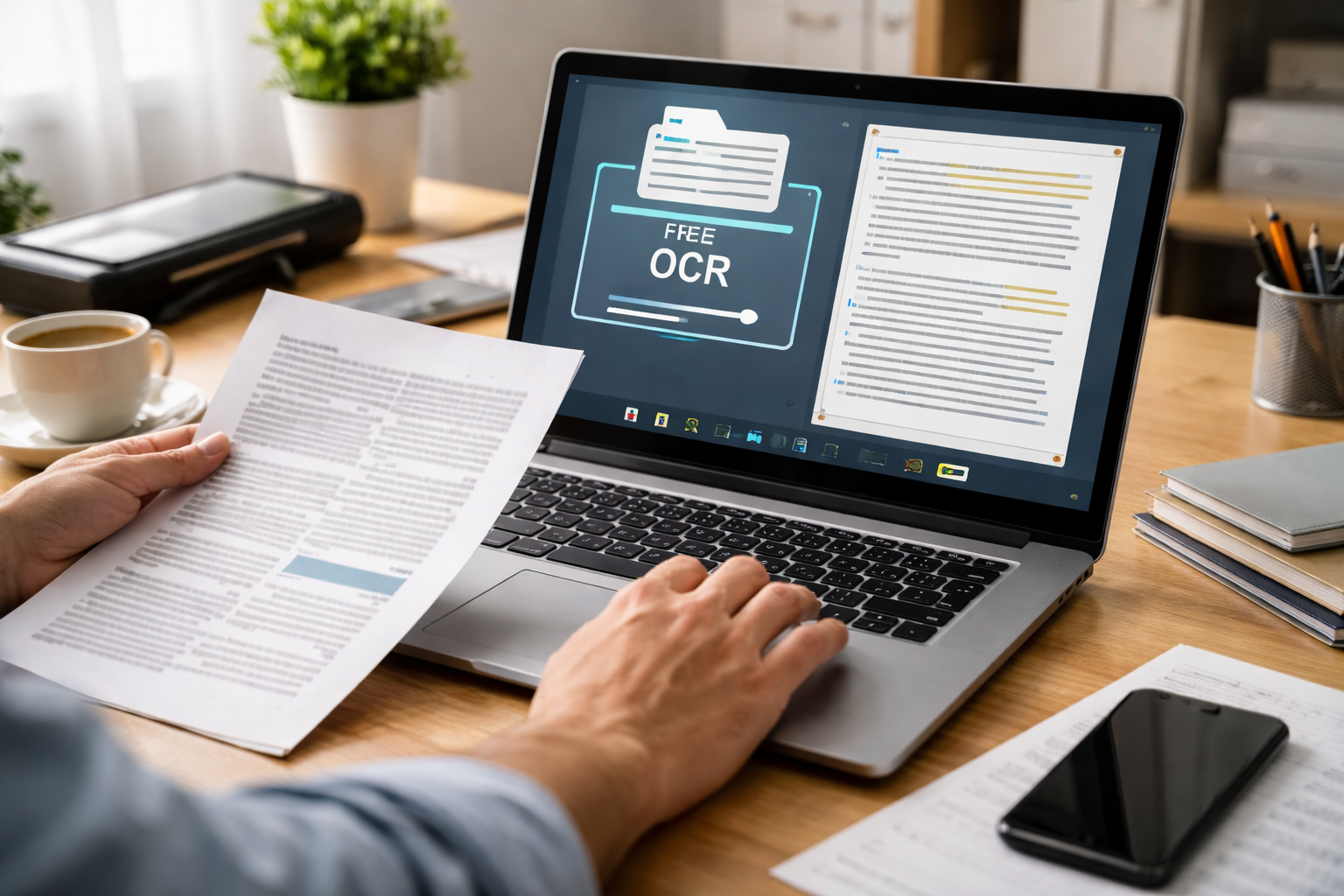
Optical Character Recognition (OCR) software converts images of text into machine-readable text. It allows users to edit, search, and copy text from scanned documents, photographs, or PDFs. The process typically involves several stages. First, the software pre-processes the image, which may include de-skewing, de-noising, and adjusting contrast. Next, it identifies individual characters or words. Finally, it converts these identified characters into a digital text format. This technology is foundational for digital document management and accessibility.

Contents
- 0.1 The Mechanism of OCR
- 0.2 Cost Savings
- 0.3 Increased Productivity
- 0.4 Enhanced Accessibility
- 0.5 Accuracy of Text Recognition
- 0.6 Support for Multiple Languages
- 0.7 Output Formats
- 0.8 User Interface and Ease of Use
- 0.9 Batch Processing Capability
- 0.10 Desktop-Based Solutions
- 0.11 Online OCR Services
- 0.12 Assess Your Document Types
- 0.13 Determine Your Volume of Work
- 0.14 Consider Your Technical Skill Level
- 0.15 Evaluate Privacy and Security Concerns
- 0.16 1. Acquire Your Document Image
- 0.17 2. Open the Software and Upload the Document
- 0.18 3. Configure OCR Settings (if available)
- 0.19 4. Initiate the OCR Process
- 0.20 5. Review and Edit the Output
- 0.21 6. Save or Export the Converted Text
- 0.22 Optimize Your Input Images
- 0.23 Use Language Settings Correctly
- 0.24 Proofread and Correct Thoroughly
- 0.25 Leverage Batch Processing
- 0.26 Explore Advanced Features
- 0.27 Expecting 100% Accuracy Always
- 0.28 Ignoring Image Quality
- 0.29 Not Setting the Correct Language
- 0.30 Overlooking Security and Privacy for Sensitive Data
- 0.31 Skipping the Proofreading Step
- 0.32 Digitizing Historical Documents
- 0.33 Managing Receipts and Invoices
- 0.34 Converting Research Papers
- 0.35 Accessibility for Visually Impaired Individuals
- 0.36 Automating Data Entry
- 0.37 Enhanced AI and Machine Learning Integration
- 0.38 Automation and Workflow Integration
- 0.39 Cloud-Native Solutions
- 0.40 Focus on Specific Niches
- 0.41 Multimodal OCR
- 1 FAQs
The Mechanism of OCR
OCR software works by analyzing the patterns of dark and light pixels in an image. When it encounters a block of text, it attempts to match these patterns to known character shapes. Early OCR systems relied on templates and matched pixels directly. More advanced systems use feature extraction, identifying lines, curves, and angles that compose each character. Modern OCR often incorporates machine learning, allowing the software to learn and adapt to new fonts and handwriting styles, improving accuracy over time. This approach, similar to how the human brain learns to recognize letters, makes the software more robust to variations in input.
Free OCR software provides accessible tools for converting static text into editable formats. This capability offers several advantages for individuals and businesses managing documentation.
Cost Savings
The primary benefit of free OCR software is the absence of a financial outlay. For small businesses, students, or individuals with occasional OCR needs, this eliminates a budget consideration. Instead of investing in expensive commercial solutions, users can access core OCR functionalities without cost. This accessibility levels the playing field, making advanced document handling available to a broader audience.
Increased Productivity
Manual data entry from scanned documents is time-consuming and error-prone. Free OCR software automates this process. Imagine a river of paper documents flowing into your office; without OCR, each document is a rock blocking the flow. OCR acts as a dam that smooths the passage, converting these static images into searchable, malleable data. This speed and accuracy free up human resources for more complex tasks. For example, rather than typing out information from invoices, employees can use OCR to extract key data directly, reducing processing time.
Enhanced Accessibility
Converting scanned documents into editable text makes them accessible to screen readers and other assistive technologies. This is crucial for individuals with visual impairments or other disabilities. Beyond specialized tools, searchable text enhances general document accessibility. Users can quickly locate specific information within large documents, bypassing the need for a manual scan of each page. This transforms a static artifact into a dynamic resource.
When selecting free OCR software, certain features distinguish effective tools from less useful ones. These features enhance usability and the quality of the output.
Accuracy of Text Recognition
The core function of OCR is accurate text conversion. A high-quality free OCR tool should minimize errors in character recognition. Look for software that consistently recognizes various fonts, sizes, and print qualities. Some software excels with clear, machine-printed text, while others might struggle with slightly distorted or handwritten input. It is important to test the software with documents similar to those you typically handle. Poor accuracy is like a broken compass; it directs you, but often to the wrong destination.
Support for Multiple Languages
In a globalized world, documents often contain text in several languages. Good free OCR software supports a wide range of languages, not just English. This feature is crucial for international businesses, researchers, or anyone dealing with multilingual content. The presence of language packs or automatic language detection improves versatility.
Output Formats
After recognizing text, the software needs to export it into usable formats. Common output formats include plain text (.txt), Microsoft Word (.docx), PDF, and sometimes searchable PDF. The ability to export to various formats gives you flexibility in how you use the converted document. For example, a searchable PDF allows you to keep the original document’s layout while also making its text searchable.
User Interface and Ease of Use
An intuitive user interface simplifies the OCR process. The software should be easy to navigate, with clear instructions for uploading documents, selecting options, and initiating conversion. A complex interface, like a maze, can deter users and reduce efficiency. Drag-and-drop functionality, clear buttons, and logical workflows contribute to a positive user experience.
Batch Processing Capability
For users dealing with numerous documents, batch processing is a valuable feature. This allows the software to process multiple image files or PDFs simultaneously, rather than one by one. It saves significant time and effort, especially when converting large archives of documents.
The market offers several free OCR solutions, each with its strengths and weaknesses. This section categorizes some prominent options.
Desktop-Based Solutions
- Tesseract OCR: Developed by Google, Tesseract is an open-source OCR engine. It is highly accurate and supports over 100 languages. However, it is primarily a command-line tool, which means it lacks a graphical user interface (GUI) on its own. Users often integrate it with front-end applications like FreeOCR or gImageReader to provide a more user-friendly experience. Tesseract is a powerful engine, a robust gearbox, but it requires a chassis to be truly driven. Its strength lies in its raw capability and flexibility for developers.
- NAPS2 (Not Another PDF Scanner 2): This tool is designed primarily for scanning documents, but it includes robust OCR capabilities powered by Tesseract. NAPS2 offers a simple GUI, allowing users to scan documents directly, perform OCR, and save them as searchable PDFs or image files. It’s user-friendly and an excellent choice for those who need a unified scanning and OCR solution.
- FreeOCR: As its name suggests, FreeOCR is a free desktop application that utilizes the Tesseract OCR engine. It provides a straightforward interface for opening image files or PDFs, performing OCR, and exporting text. While it’s relatively basic in features, its simplicity makes it easy to use for quick conversions.
Online OCR Services
- OnlineOCR.net: This web-based service allows users to upload images or PDFs and convert them into editable formats. It supports various languages and output formats like DOCX, XLSX, and TXT. OnlineOCR.net typically offers a quota for free conversions per hour or day. It’s a convenient option for occasional use without software installation.
- Google Docs (built-in OCR for images): Google Docs has an integrated OCR feature. When you upload an image or PDF to Google Drive, you can open it with Google Docs, which then attempts to convert the image text into editable text within the document. Its accuracy is often good for clearly printed documents, and it benefits from Google’s deep learning expertise.
- Smallpdf OCR: This is part of a larger suite of PDF tools. Smallpdf offers an OCR feature that converts scanned PDFs into editable text. It is generally accurate and user-friendly, providing a clean interface. Like other online services, it often has limitations on the number of free conversions.
Selecting the correct free OCR tool requires understanding your specific requirements and the software’s capabilities.
Assess Your Document Types
Consider the kind of documents you typically process. Are they mostly clear, machine-printed invoices, or are they historical records with faded text and varying fonts? If your documents are consistent and high-quality, most free OCR tools will suffice. If you deal with less ideal inputs, such as images with complex layouts, handwriting, or low resolution, you’ll need an OCR engine known for its robustness, perhaps one powered by Tesseract or advanced AI. This is like choosing a fishing net; a wide-mesh net works for large fish, but you need a fine-mesh one for small fry.
Determine Your Volume of Work
How many documents do you need to convert? For a few documents now and then, an online OCR service or Google Docs’ built-in feature might be perfect. For daily, high-volume processing, a desktop application with batch processing capabilities like NAPS2 is more suitable. Online services often have daily limits that can hinder large-scale tasks.
Consider Your Technical Skill Level
Some free OCR options, like raw Tesseract, require comfort with command-line interfaces. If you prefer a point-and-click experience, look for software with a clear graphical user interface. Online tools are generally the easiest to use, requiring no installation or technical setup.
Evaluate Privacy and Security Concerns
For sensitive documents, consider the privacy implications of using online OCR services. When you upload a document to a web server, you are entrusting your data to that service provider. Desktop-based solutions process documents locally on your computer, eliminating third-party data access risks.
The basic process for using most free OCR software is similar, though details may vary.
1. Acquire Your Document Image
Begin by having your document in an image format (JPEG, PNG, TIFF) or a scanned PDF. You can use a scanner, a smartphone camera, or take a screenshot of a digital document. Ensure the image is clear, well-lit, and aligned as much as possible to maximize OCR accuracy.
2. Open the Software and Upload the Document
Launch your chosen free OCR software. Locate the “Open,” “Upload,” or “Add File” option. Select the image or PDF file you wish to process. If you’re using an online service, you’ll drag and drop the file into a designated area.
3. Configure OCR Settings (if available)
Some software allows you to specify settings like the document language, output format, or areas of the document to OCR. For example, if your document is in German, select German as the language to improve accuracy. If you only need text from a specific section, some tools offer a selection box.
4. Initiate the OCR Process
Click the “Recognize,” “Convert,” or “Start OCR” button. The software will then process the image. This can take anywhere from a few seconds to several minutes, depending on the document length, image quality, and processing power.
5. Review and Edit the Output
Once the OCR process is complete, the software will display the converted text. It is crucial to review this text for errors. No OCR software is 100% accurate, especially with less-than-perfect inputs. Correct any misplaced characters, formatting issues, or missed words. This review step is your quality control, like checking a freshly cut piece of wood for splinters.
6. Save or Export the Converted Text
Finally, save the corrected text in your desired output format (e.g., plain text, Word document, or searchable PDF). Most software will provide options for where to save the file on your computer or in cloud storage.
Optimizing your use of free OCR software can significantly enhance its utility.
Optimize Your Input Images
The quality of your input image is the primary determinant of OCR accuracy. Ensure documents are scanned or photographed straight, well-lit, and in high resolution. Remove unnecessary backgrounds. If an image is skewed, use image editing software to straighten it before OCR. Think of input images as seeds; well-prepared soil yields a better harvest.
Use Language Settings Correctly
Always select the correct language for your document within the OCR software. This guides the OCR engine to use the right character sets and dictionaries, dramatically improving accuracy. If your document contains multiple languages, some advanced OCR tools allow for multi-language recognition.
Proofread and Correct Thoroughly
Consider the OCR output as a draft. It needs review and editing. Automated OCR saves the heavy lifting, but human oversight ensures precision. For lengthy documents, divide the proofreading into smaller, manageable sections.
Leverage Batch Processing
If your chosen software supports batch processing, use it. This feature converts multiple documents in one go, saving you the time of repeatedly initiating individual conversions.
Explore Advanced Features
Even free software can have advanced features like zone OCR (specifying only certain areas for conversion) or the ability to train the OCR engine for specific fonts. Explore the software’s documentation or help section to uncover these capabilities.
Avoiding common pitfalls will streamline your OCR experience.
Expecting 100% Accuracy Always
No OCR software is perfect. It’s a tool, not a human reader. Expecting flawless conversion every time, especially from poor-quality documents, leads to frustration. Always plan for a proofreading step.
Ignoring Image Quality
Using blurry, low-resolution, or shadowy images is a recipe for poor OCR results. The software can only work with the information it’s given. A poor image is like a faint whisper; even the best listener will struggle to understand.
Not Setting the Correct Language
This is a frequent oversight that significantly impacts accuracy. An English OCR engine trying to interpret Polish text will produce garbled output because it lacks the correct character set and dictionary.
Overlooking Security and Privacy for Sensitive Data
For documents containing personal or confidential information, be cautious about using online OCR services. Understand their data handling policies or opt for desktop-based solutions where your data remains on your device.
Skipping the Proofreading Step
Relying solely on the OCR output without review can lead to errors propagating into your data. A small mistake in OCR can have significant consequences in things like financial records or legal documents.
Free OCR software serves diverse needs across various sectors.
Digitizing Historical Documents
Archivists and historians often labor over fragile paper documents. Free OCR can transform these into searchable text, allowing researchers to quickly find names, dates, or keywords across vast collections. A library of static paper gains a digital index.
Managing Receipts and Invoices
Small business owners can use free OCR to extract data from receipts and invoices. Instead of manually entering expenses into accounting software, they can OCR the documents, pull out the necessary figures, and integrate them, speeding up bookkeeping.
Converting Research Papers
Students and academics frequently encounter PDF research papers or scanned book chapters. Free OCR allows them to convert these into editable text, making it easier to copy quotes, annotate, or search for specific information for their studies.
Accessibility for Visually Impaired Individuals
By converting scanned documents or images of text into machine-readable format, free OCR software enables screen readers to vocalize the content. This opens up a world of information for those with visual impairments.
Automating Data Entry
In offices, forms often come in paper format. Free OCR can automate parts of the data entry process by extracting key information from these forms, reducing the manual effort involved and minimizing human error.
The evolution of OCR technology, even in its free iterations, points towards more powerful and integrated tools.
Enhanced AI and Machine Learning Integration
Future free OCR software will increasingly leverage advanced AI and machine learning models. This means improved accuracy, especially for challenging inputs like poor-quality scans, diverse fonts, and even complex handwriting styles. It will be like teaching a child to read, but at an accelerated pace with vast learning resources. For your work, this translates to less time spent on proofreading and higher confidence in converted data.
Automation and Workflow Integration
Expect free OCR tools to integrate more seamlessly into existing workflows. This could mean direct links to cloud storage services (like Dropbox or Google Drive) or even basic automation features that clean up output, categorize documents, or trigger follow-up actions once text is extracted. This makes OCR less of a standalone task and more of an invisibly integrated component of your digital operations.
Cloud-Native Solutions
As internet speeds increase and cloud computing becomes more prevalent, free OCR solutions will likely become predominantly cloud-native. This eliminates the need for software installation, allows for ubiquitous access from any device, and leverages scalable cloud processing power for faster conversions. Your computer becomes a window, not the engine, for OCR.
Focus on Specific Niches
While general-purpose OCR will improve, niche-specific free OCR tools may emerge, optimized for particular document types (e.g., medical records, legal documents, financial statements). These tools would have specialized dictionaries and recognition patterns, leading to even higher accuracy for those specific applications.
Multimodal OCR
Future OCR may not just extract text but also understand the context of images and layouts. This means not just converting text but knowing that the text “Invoice Number: 12345” refers to an actual invoice number within a larger document structure. This cognitive leap will give free OCR software a deeper understanding of your documents, turning raw text into structured, actionable data. This moves beyond simple transcription to true understanding.
FAQs
What is OCR software, and how does it work?
OCR stands for Optical Character Recognition, which is a technology that enables the conversion of different types of documents, such as scanned paper documents, PDF files, or images captured by a digital camera, into editable and searchable data. OCR software works by analyzing the patterns of light and dark in the document and converting it into machine-encoded text.
The Benefits of Using Free OCR Software for Your Workload
Using free OCR software can significantly reduce the time and effort required for manual data entry and document conversion. It can also improve accuracy and consistency in document processing, as well as enable keyword search and retrieval of information from scanned documents.
Top Features to Look for in Free OCR Software
When choosing free OCR software, it’s important to look for features such as multi-language support, image pre-processing capabilities, output formats (e.g., Word, Excel, searchable PDF), batch processing, and integration with cloud storage services.
How to Choose the Right Free OCR Software for Your Needs
To choose the right free OCR software for your needs, consider factors such as the types of documents you need to process, the volume of documents, the languages used in the documents, and the level of accuracy and formatting preservation required.
Step-by-Step Guide to Using Free OCR Software for Document Conversion
Using free OCR software for document conversion typically involves importing the document into the program, selecting the language and output format, adjusting any preprocessing settings, and initiating the OCR process. After the conversion, the text can be edited and saved in the desired format.

Hamza Khan is the author and founder of TechFixLogic.info, a platform dedicated to providing practical software guides, tech solutions, and cybersecurity awareness. With a strong interest in technology and digital security, Hamza focuses on creating easy-to-understand tutorials that help users fix software issues, improve their digital skills, and stay safe online.
Through TechFixLogic.info, he shares step-by-step guides, troubleshooting tips, and cybersecurity insights designed for beginners as well as regular computer users. His goal is to simplify technology and make reliable tech knowledge accessible to everyone.


